Wednesday, June 3, 2015
June: Last Month of Sabbatical
I need to thank Hope College for the great opportunity of a year-long sabbatical. It has been fantastic: Papers presented at four international business conferences; four papers published in peer-reviewed journals; book on corporate longevity written and ready to submit to publishers; regular updates to my blog and twitter feed on corporate longevity; data base on century-old U.S. firms validated (up to 1875 - still have quite a bit to go); eight countries visited; time to do a driving trip to Florida to visit my 86 and 88-year-old parents (with a stop in Savannah along the way); and a brand-new granddaughter! What a year!!!
Now it's time to start thinking about getting back into teaching (I need to redo my Management Seminar since the book I used in the past is out of print, plus I've been asked to move to a MWF schedule which means more, shorter class sessions each week - not quite sure how to do a seminar course with that format but I'll figure it out). I have already started meeting with the Baker Scholars officers to start planning for the coming year's activities. Since my office is still occupied by my replacement and I am technically still on sabbatical until July, I will continue to work from home - and spend as much time as I can with my sweet granddaughter!
Wednesday, May 13, 2015
May: Book progress and Granddaughter!
May is a beautiful time in Holland, Michigan - tulips and flowering trees make my daily walks a joy. Nick was home for a week between semesters, hoping his new niece would be born while in Holland, but no such luck. Little girl Sale will arrive when she wants to, not when the doctor says she is due.
I've been doing daily work on my data base of 100-year-old companies (verifying they are still independent operating companies), making daily "tweets" about old companies, and adding bits to the book draft. I have also started posting excerpts of chapters from the book on my blog and sent a draft of the whole book to Hope's PR firm to get their opinion on whether it is worth pursuing any further. In a conversation with the firm's president he told me the book is definitely "sellable" and he thinks there will be publishers interested in it. He gave me the names of some people to contact (their PR firm doesn't work with book publishers) and wished me luck. Now I just have to decide how serious I am about pursuing this.
I have committed to making a presentation on my research to HASP (Holland Area Senior Professionals) in the fall on my old company research and have made some additional plans for the trip to Portugal this summer for the GBATA conference. Just trying to keep busy while we wait!
| We had a fun Mother's Day even without a new baby |
And finally on May 20 (2 weeks late) the arrival into this world of Audrey Victoria Sale! 8 lbs, 3 oz & 20" long. We are all in love!!!
Wednesday, April 8, 2015
April: Spring has arrived (sort of)
Spring is coming, but slowly. At least I can walk on snow-free sidewalks even if I do still need to bundle up.
Paper revisions for the July GBATA conference have been made and the paper is sent. Conference registration complete; flight to Portugal and hotel reservations made. Now it's back to working on the book.
This month also draws me back into Hope with registration taking place for fall courses and managing wait list requests. My seminar will require a complete overhaul, not only because the book I used to use is now out of print, but because I've been asked to change from a T-R 80-minute class schedule to M-W-F 50-minutes. Not sure how a seminar class will work with 50 minute discussion periods, but I'll give it a try.
Nick came home for the Easter weekend and Alison & Scott came over for dinner on Sunday.
It was great to have everyone all together, though Alison is not feeling great (she has a torn abdominal muscle that causes her pain). As far as she's concerned the baby can come any time and the sooner the better.
I have finished a first draft of my book! It's tentatively titled "Survival is the Ultimate Performance Measure: Management Practices of the Corporate Century Club." I don't think I have enough information for a book - half of it is the list of U.S. companies over 100 years old - but if I do get a publisher interested, I will need to verify the nearly 1200 companies on the list. I feel good about getting it to this point regardless, plus I have something to report for how I spent the second semester of my sabbatical. Now I do daily Twitter posts on companies that are over 100 and look for information about them that might be interesting to add to the book. As a result, the book is looking more and more like information on individual old companies that help illustrate the longevity factors we identified in the research. It's possible that reading about real companies will interest people more than the research results. We'll see.
Paper revisions for the July GBATA conference have been made and the paper is sent. Conference registration complete; flight to Portugal and hotel reservations made. Now it's back to working on the book.
This month also draws me back into Hope with registration taking place for fall courses and managing wait list requests. My seminar will require a complete overhaul, not only because the book I used to use is now out of print, but because I've been asked to change from a T-R 80-minute class schedule to M-W-F 50-minutes. Not sure how a seminar class will work with 50 minute discussion periods, but I'll give it a try.
Nick came home for the Easter weekend and Alison & Scott came over for dinner on Sunday.
It was great to have everyone all together, though Alison is not feeling great (she has a torn abdominal muscle that causes her pain). As far as she's concerned the baby can come any time and the sooner the better.
I have finished a first draft of my book! It's tentatively titled "Survival is the Ultimate Performance Measure: Management Practices of the Corporate Century Club." I don't think I have enough information for a book - half of it is the list of U.S. companies over 100 years old - but if I do get a publisher interested, I will need to verify the nearly 1200 companies on the list. I feel good about getting it to this point regardless, plus I have something to report for how I spent the second semester of my sabbatical. Now I do daily Twitter posts on companies that are over 100 and look for information about them that might be interesting to add to the book. As a result, the book is looking more and more like information on individual old companies that help illustrate the longevity factors we identified in the research. It's possible that reading about real companies will interest people more than the research results. We'll see.
Friday, March 13, 2015
March: Work on that book!
With a little push from Hope's PR firm I have finally started serious work on my book about old companies. I'd like to get a little more flesh on the skeleton before running it past them to see if it's worth continuing to work on. My dilemma is this: I know people will be most interested in stories about real companies, but when books profile specific companies it not only invites criticism (no one is perfect, and that applies to companies too) but risks questioning the principles themselves (not all companies profiled in the book Good to Great are still great, or even operating). The fact that there are statistically significant differences in the practices of old companies compared with young ones doesn't mean all old companies practice these principles, nor does practicing all the principles guarantee that a company will survive. Our research has identified certain practices that correlate with longevity, but that doesn't make them causal. So the approach I'm thinking about using is to give company examples for each factor in the theoretical model, but not to profile specific companies as a whole. I may also include my data base of companies over 100 years old (or those founded before 1900, or before World War I) in the appendix since people always ask what companies are on the list. We'll see. Built to Last, Enduring Success, Managing for the Long Run, are all titles of previous books profiling very large, public corporations. I'm struggling to come up with an appropriate title for my book. Perhaps Survival is the Ultimate Performance Measure? (this is a quote from Ian Davis, former managing partner of McKinsey). Or Secrets of the Corporate Century Club?
I attended the TEDxMacatawa event in Holland. I had attended two of the original TED events in California when I was still at Herman Miller and was interested to see how well these local events do in comparison. It was interesting to hear local people present interesting ideas. The 18-20 minute time limit keeps things moving. Most enjoyable were the conversations during breaks with former Herman Miller colleagues, former Hope students, former and current neighbors and friends.
The month also included a couple of short trips: Detroit to help Nick celebrate his 26th birthday and to Ann Arbor to reminisce with Randy and Babette about our recent trips to Australia and New Zealand. And a baby shower for Alison!
The month ended with intense work on my paper for the summer GBATA conference. The good news is that it was accepted for presentation and inclusion in their readings book; the bad news is that the reviewers requested significant revisions. I was able to address all their concerns, except the request to include the names of companies we surveyed, since we had promised anonymity to participants. By the time I added or revised things, the paper was three pages over the limit for the readings book so I had to do some major editing. I think I finally have it ready to go. My opinion: the revisions suggested by the reviewers did make it a stronger paper, but the longer version is better than the edited one.
I attended the TEDxMacatawa event in Holland. I had attended two of the original TED events in California when I was still at Herman Miller and was interested to see how well these local events do in comparison. It was interesting to hear local people present interesting ideas. The 18-20 minute time limit keeps things moving. Most enjoyable were the conversations during breaks with former Herman Miller colleagues, former Hope students, former and current neighbors and friends.
The month also included a couple of short trips: Detroit to help Nick celebrate his 26th birthday and to Ann Arbor to reminisce with Randy and Babette about our recent trips to Australia and New Zealand. And a baby shower for Alison!
The month ended with intense work on my paper for the summer GBATA conference. The good news is that it was accepted for presentation and inclusion in their readings book; the bad news is that the reviewers requested significant revisions. I was able to address all their concerns, except the request to include the names of companies we surveyed, since we had promised anonymity to participants. By the time I added or revised things, the paper was three pages over the limit for the readings book so I had to do some major editing. I think I finally have it ready to go. My opinion: the revisions suggested by the reviewers did make it a stronger paper, but the longer version is better than the edited one.
Thursday, February 5, 2015
February: Database & Blog Work; New Paper Finished; Florida
To escape the bitter cold and snow in Michigan, we planned a driving trip to Florida in February. It was delayed a bit because of some bug John caught, but we still made it later in the month. In the meantime, I was able to do quite a bit of work updating my database of 100-year-old companies, finding additional information on some companies celebrating 125th, 130th, and 150th anniversaries in 2015, identifying 4th generation family-owned companies for a PR firm working on an article profiling a company turning 100 this year, and searching out firms established in 1915 to add to the database. Much of this work will end up on my blog and daily tweets.
The real work this month has been writing, editing, and formatting a paper for the summer GBATA conference to be held in Portugal. After several rewrites and edits, it feels good to have it finished and sent it off to the reviewers. I've also been working on editing the paper proposal Makoto Kanda and I presented at the Strategic Management Society Conference in Sydney. I'm awaiting the tables Mako is preparing before submitting it to the SMS Global Strategy Journal. Feeling good about having two papers in the works.
![]() |
| Savannah Bed & Breakfast Inn |
On our way to Florida we stopped in beautiful Savannah for a few days and stayed at a delightful B&B in the historic district, which made for convenient walks around the city to see each of the 22 squares plus a cemetery and a few parks. Had our best meal of the trip in the shrimp and grits breakfast at the Savannah Bed & Breakfast Inn - not something I would ever have ordered from a menu, so I'm glad we didn't have a choice!
The Inn's front door (just across from Chatham Square) and back courtyard.
| It was great to see sunshine, green leaves, and blooming plants. |
Then it was on to Leesburg, Florida to visit my parents. It was great to see them doing so well - and John even played cards! (Up and Down the River and Pinocle)
![]() |
| Looking good at 86 and 88 - and they still beat me at cards. |
Upon returning to Michigan, we had more record cold and snow to endure before the month ended. Not able to do my walking routine because of the weather, I finally started work on my book! (No more excuses.) Whenever I present my research on old companies, people would encourage me to write a book about it because they thought the information would appeal to the general business population, not just academics. I'm still not sure I have enough to say for a whole book, but I'll give it a try. If I don't do this while on sabbatical, it likely won't ever get done so we'll see how it goes.
Wednesday, January 28, 2015
January: Writing, Walking, and Detroit
Early in the month I had a meeting with my research partner, Makoto Kanda, and we scoped out our work for the coming year. I will write and submit for publication our paper comparing strategies of 100-year-old companies in Japan and the U.S.; he will analyze the data he has obtained on the innovation approach used by old companies and get that to me for writing another paper. We will aim for the July GBATA conference in Portugal for presenting the findings. In April Mako will host a BBC reporter (she had interviewed the two of us for an article in 2013) who wants to conduct case studies on old Japanese companies (shinise) and write a book. Though he'd like me to be there to help out, I will likely pass since I don't want to chance being gone when Alison goes into labor (she is due early May).
Trying to stay healthy by walking in January in Michigan is not easy. Fortunately in Holland we have snowmelt downtown so I am able to avoid the icy sidewalks and still get in 3-4 miles each day. A much more interesting walk than doing the treadmill route.
January ended with a trip to Detroit to visit Nick. We spent the day at the Detroit Institute of Arts, enjoyed a fun evening at the Whitney's "Ghost Bar," and stayed at the historic Inn on Ferry Street - an interesting group of large old houses that have been transformed into a hotel/bed & breakfast spot in Midtown. All our activities were within walking distance of each other (and close to New Center, where Nick lives).
![]() |
| Nick in front of the DIA (or a thinker in front of The Thinker) |
![]() |
| Some of the houses forming the Inn on Ferry Street |
![]() |
| A fun evening at The Whitney - another old house re-purposed. |
Friday, December 19, 2014
December: Strategic Management Society Conference in Sydney, Australia
Since my research partner, Makoto Kanda, is in Tokyo and has little time available to travel (he is currently working both as a professor and as assistant to his university's president), we chose the Strategic Management Society's conference in Sydney, Australia to present the results of our most recent work comparing the behaviors of old companies in Japan and the United States. An SMS conference is a great place to get feedback since their members include business executives and consultants in addition to academics.
I have long wanted to travel to Australia and New Zealand so - though I would have preferred going in January or February rather than trying to fit the trip in between Thanksgiving and Christmas - John and I left soon after Thanksgiving for Auckland, New Zealand. That way I had a week to recover from the very long trip and adjust to local time before the conference. So, first a little about New Zealand, then the conference, and then our travels in Australia.
Auckland, New Zealand: They call Auckland the "City of Sails." It is surrounded by water and there are boats everywhere one looks: commuter ferries, touring ferries, and lots of sailboats. The weather was cool and often drizzling while we were there, but that didn't interfere with our exploring the city. Though much of the city of Auckland is bland and not very remarkable, we enjoyed walking through the park, along the harbor, and trips to Devonport and Waikeke Island.
| This red fence runs all along the old harbor. |
| The bell tower of Auckland University as seen from Albert Park. |
| Albert Park was a delightful walk in the center of Aukland. |
The main activity on Devonport is a walk up Mt. Victoria from which one gets gorgeous views of Auckland and the volcano, Rangitoto Island.
A view of Rangitoto Island from the top of Mt. Victoria in Devonport; below, a sampling of the cute little Victorian cottages in Devonport.
|
The Auckland ferry port has two of the more interesting buildings in Auckland - the old harbor building in the background and the new one in front. |
We wanted to see a bit of the New Zealand countryside so took a bus ride to Rotorua that stopped in several cities and towns along the way - including Hamilton, which is home to Waikato University where I applied for a Fulbright Grant. (The Fulbright Commission in DC lost my letter of invitation so I didn't get the grant, but I'm glad I didn't: everything worked out for the best since I would have been in New Zealand when Alison and Scott's baby is due. Plus, after seeing Hamilton, John couldn't imagine what he would have done there for three months.) Also on the route to Rotorua was a stop at Matamata, home of "Hobbiton" - the movie set for the Shire in Lord of the Rings. Almost everyone exited the bus at that point.
The geography of this area is very interesting - not the dramatic mountains of the South Island of New Zealand, but beautiful rolling grasslands with lots of strange mounds.
I wanted to visit Rotorua for two reasons: its geology is unique - it has the same type of "hot pots" and geysers seen only in Iceland and Yellowstone Park - and it is the center of the Maori culture in New Zealand.
![]() |
| I also found a nice Maori koru pendant. |
And did you know there are two kinds of kiwi? Gold and green. The gold ones are sweeter and juicier - and likely don't travel as well as the hard, little green ones, which is perhaps why we don't see them in the U.S.
| Our New Zealand breakfasts: John's smoked salmon, pickled onions and capers in the back; my yummy yogurt (both here and in Australia, the best I've ever had) with kiwis and cheese. |
Australia: Soon it was time to be off to Sydney for the SMS Conference. Sydney welcomed us with a spectacular lightning storm.
The morning after our arrival turned out to be a beautiful day. The conference didn't start until evening so we had time to explore the Sydney landmarks. First, though, breakfast at the Circular Quay with great views of the harbor - and some colorful visitors at the next table.
The Sydney Opera House and Harbor Bridge.
During a beautiful walk through the Botanical Gardens we stopped at the outdoor cafe for a "flat white" - like a cappuccino only less foamy. (Just heard that Starbucks is planning to add flat whites to their U.S. menu!)
We met Andrew Burdick, who is working in Sydney, for lunch after which he took us on a brief walking tour of the CBD (Central Business District), including his office building (one of the very nice modern buildings in Sydney), the historic Hyde Park Barracks - a beautiful building constructed in 1819 to house convicts, and a walk through Hyde Park.
The weather was so nice we had to keep reminding ourselves it was December. The next morning all the streets around our hotel were closed off for a "Santa run."
Then in was time for the conference. Makoto Kanda, my research partner, flew in from Japan and we had a great response to our paper. Several people stayed after our session to discuss our research and encourage us to publish.
| We had great conversations with conference participants from Japan and Taiwan at the closing dinner. |
| Manly's main beach |
| It was much more of a "hike" than we were prepared for, so stopped at a cafe on Little Manly Beach - amazingly great food at a tiny little shack (seafood platter for John and lamb salad for me). |
| On the ferry ride back we had more amazing views of the Sydney Opera House - I never tired of this view. |
I had this mental image of Australia being flat, dry, and hot. Wrong. At least the east coast of the country where we were was hilly, damp (we had rain almost every day), breezy, and comfortable. This was reinforced during our day trip to the Blue Mountains, which are part of the dividing range between Eastern Australia and the rest of the country.
We signed up for a van tour to the Blue Mountains and had a driver/guide who was very knowledgable about Australian history, including the indigenous people. On this trip I also learned the difference between the "bush" and the "outback:" The outback is the vast, remote, arid area of Australia - we didn't go there. The "bush" refers to any lands outside the main urban area, and that's what we visited both on our trip to the Blue Mountains and on our trip to Hunter Valley.
| Our first view of the Blue Mountains |
| Wombats |
| Didn't realize there were so many kinds of wallabies, including these tiny little rat-like ones |
| Echidnas |
| More wallabies |
| And, yes, there were koalas! |
| Emus and kangaroos |
| This one has a baby in her pouch |
| Southern Cassowary - that's a big "horn" on top of its head |
We decided to take the scenic tour that included rides on a "railway, cableway, and skyway" down and back up the mountains, including a "walkway" through the temperate rain forest at the bottom (which also went by an abandoned coal mine). Though rather touristy, it was still fun and the views were spectacular.
The return trip to Sydney was on a river boat, so we got to experience yet another mode of transportation - and another great view of the Sydney Opera House
We spent our last few days in Australia in the Hunter Valley region, about a three hour drive north of Sydney. John braved driving on the left side of the road through the Sydney suburbs and the winding roads of the hilly old coal mining region and we had a wonderful end to our time in Australia.
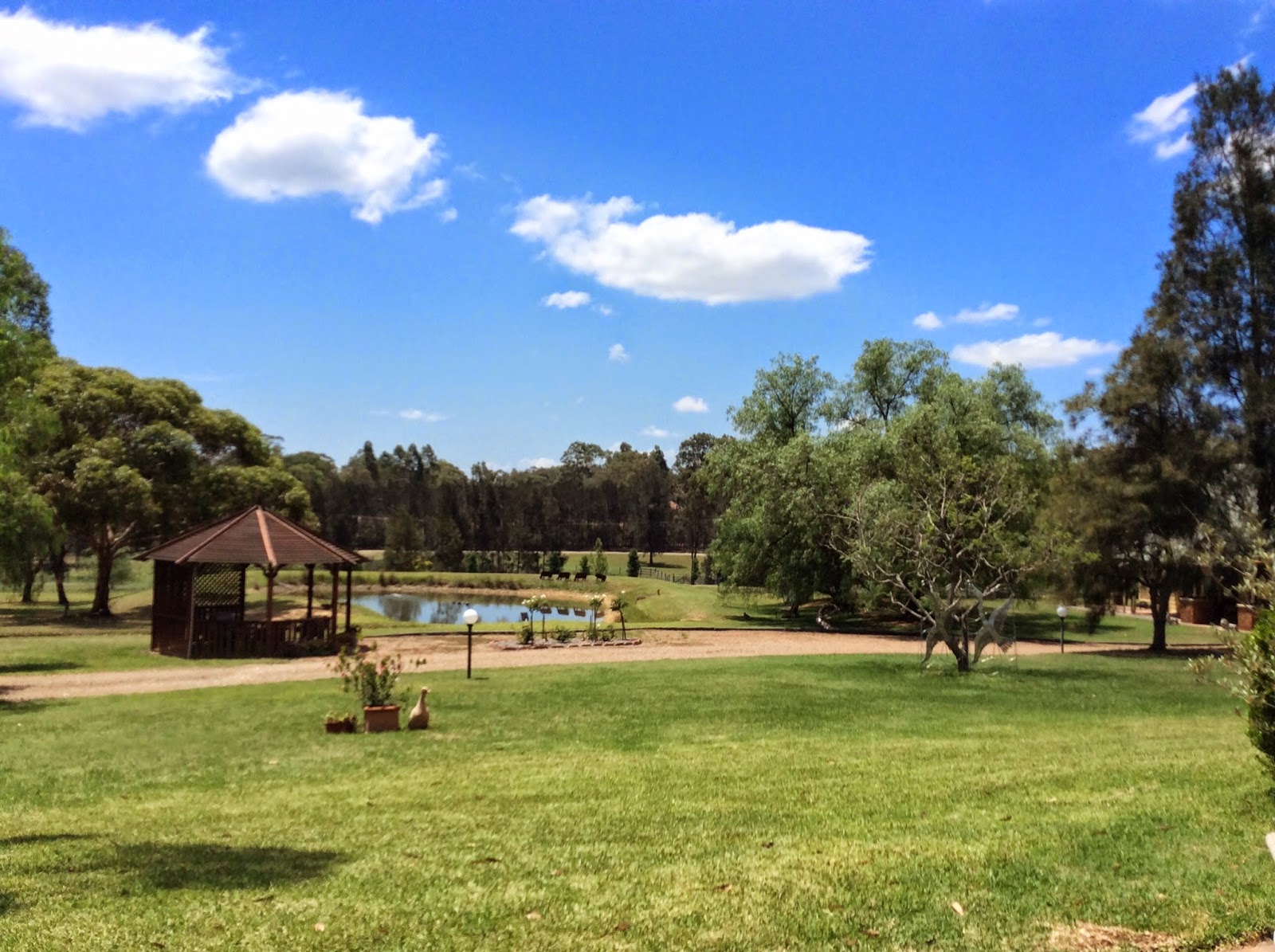
The view from the patio in front of our room at the Splinters Guest House. One evening while sitting outside watching the rain we saw a kangaroo hop through.
Besides driving around the lovely valley we enjoyed a few wine tastings at places recommended by the B&B owner. A great way to end our trip.
| Watch out for those wombats! We also saw signs for kangaroo crossing, but the road was too curvy and narrow to stop for a picture. |
| It was a relief to arrive in beautiful Hunter Valley wine country. |
The view from the patio in front of our room at the Splinters Guest House. One evening while sitting outside watching the rain we saw a kangaroo hop through.
Besides driving around the lovely valley we enjoyed a few wine tastings at places recommended by the B&B owner. A great way to end our trip.
Subscribe to:
Posts (Atom)


.jpg)
.jpg)
.jpg)


.jpg)
.jpg)